Get Quote
Get Quick QuoteService Areas
Miami, Coral Gables, Kendall, Doral, Hialeah, Aventura, Homestead
Availability
Mon-Sat: 8am-6pm
Sun: 9am-3pm
# What is Brown Grease?
Brown grease is a type of FOG that accumulates in grease traps and interceptors, consisting of a mixture of fats, oils, grease, food solids, and water that separates from wastewater. Unlike yellow grease (used cooking oil), brown grease contains food particles, water, and other contaminants that make it more difficult to process and recycle.
What it is and why it matters
Brown grease forms when FOG (fats, oils, and grease) from commercial kitchens enters grease traps along with food solids and wastewater. As these materials separate in the trap, brown grease accumulates as a semi-solid mixture containing FOG, food particles, water, and other organic matter. This composition distinguishes brown grease from yellow grease, which is relatively pure used cooking oil.
The EPA Pretreatment Program recognizes brown grease as a type of FOG that requires proper management to prevent sewer blockages. The Water Environment Federation explains that brown grease's mixed composition makes it more challenging to process than yellow grease, requiring specialized handling and disposal methods.
For restaurants and food service facilities in Miami-Dade County, understanding brown grease is important for proper grease trap maintenance. The Miami-Dade County DERM requires proper brown grease disposal to prevent environmental contamination and sewer blockages.
Need help today?
Same-day service across Miami-Dade County. Licensed & insured.
Call Miami Septic ProsTechnical breakdown
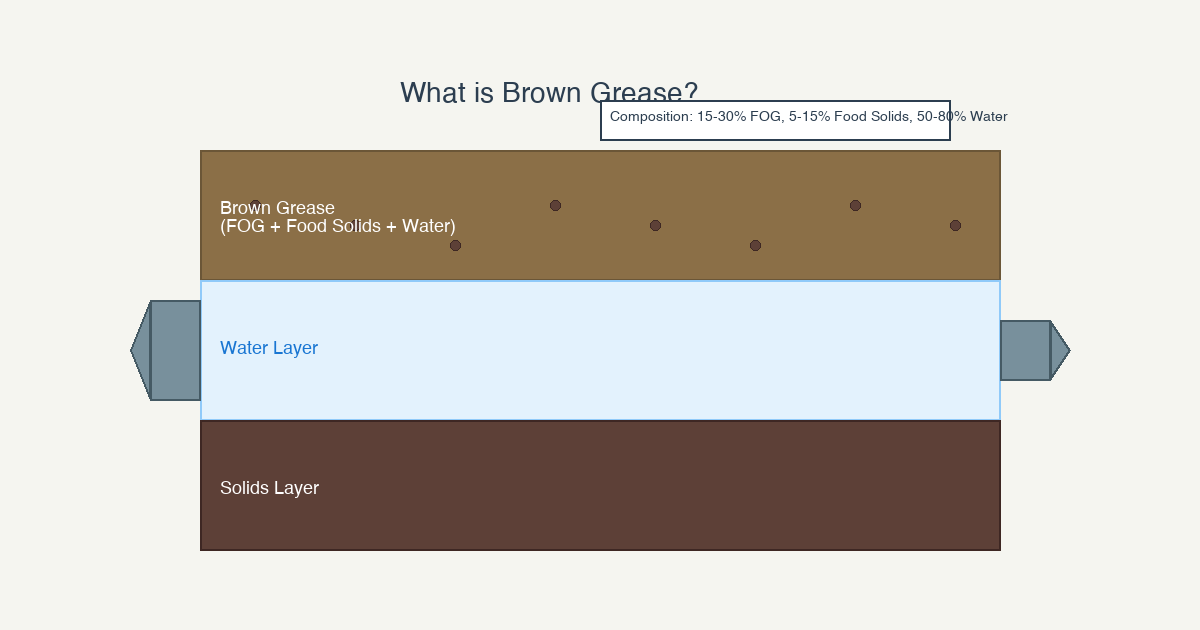
Composition: Brown grease consists of approximately 15-30% FOG, 5-15% food solids, and 50-80% water, along with other organic matter. This mixed composition results from the combination of cooking oils, animal fats, food scraps, and wastewater that enters grease traps from commercial kitchens.
Formation process: When wastewater containing FOG, food solids, and other organic matter enters a grease trap, gravity separation occurs. FOG floats to the top, food solids settle to the bottom, and water remains in the middle. Brown grease forms as the FOG layer mixes with food particles and water, creating a semi-solid, brown-colored material.
Characteristics: Brown grease has a high water content, contains food solids and organic matter, and has a lower energy value than yellow grease due to its mixed composition. The Florida Department of Health explains that brown grease's composition makes it unsuitable for direct use as biodiesel feedstock without extensive processing.
Difference from yellow grease: Yellow grease is relatively pure used cooking oil collected directly from fryers and cooking equipment, containing minimal food solids and water. Brown grease, in contrast, is the FOG that accumulates in grease traps after mixing with food solids and wastewater, resulting in a more contaminated material that requires different handling and disposal methods.
Disposal requirements: Brown grease must be disposed of by licensed waste haulers who transport it to approved treatment facilities. The EPA and local regulations prohibit dumping brown grease into sewers, drains, or the environment due to its potential to cause blockages and contamination.
South Florida notes (local relevance)
Miami-Dade County restaurants must properly manage brown grease through regular grease trap cleaning and proper disposal. The Miami-Dade County DERM requires that brown grease be removed by licensed waste haulers and disposed of at approved facilities to prevent sewer blockages and environmental contamination.
The county's high concentration of restaurants means significant volumes of brown grease are generated daily. Proper grease trap installation and maintenance ensure brown grease is effectively captured and removed before it can enter municipal sewer systems, protecting infrastructure and reducing costs.
Miami-Dade restaurants must comply with DERM requirements for brown grease management, including regular trap cleaning, proper disposal documentation, and compliance with disposal regulations. Professional grease trap services ensure brown grease is properly handled and disposed of according to local regulations.
Get a clear, no-pressure quote
Describe your job. We'll confirm price and schedule.
Get My Free QuoteFrequently Asked Questions
Related service:
Grease Trap Installation →